Use any reference image
Start from a photo, screenshot, product crop, or social post.
 Colette & CarrieFashion besties · by RemodeBack to chat
 Reverse image search
Generic reverse image search finds similar pictures. Remode is built to find clothing results with shopping context.
Search in your browser. The app is available for iPhone.
Start with a photo
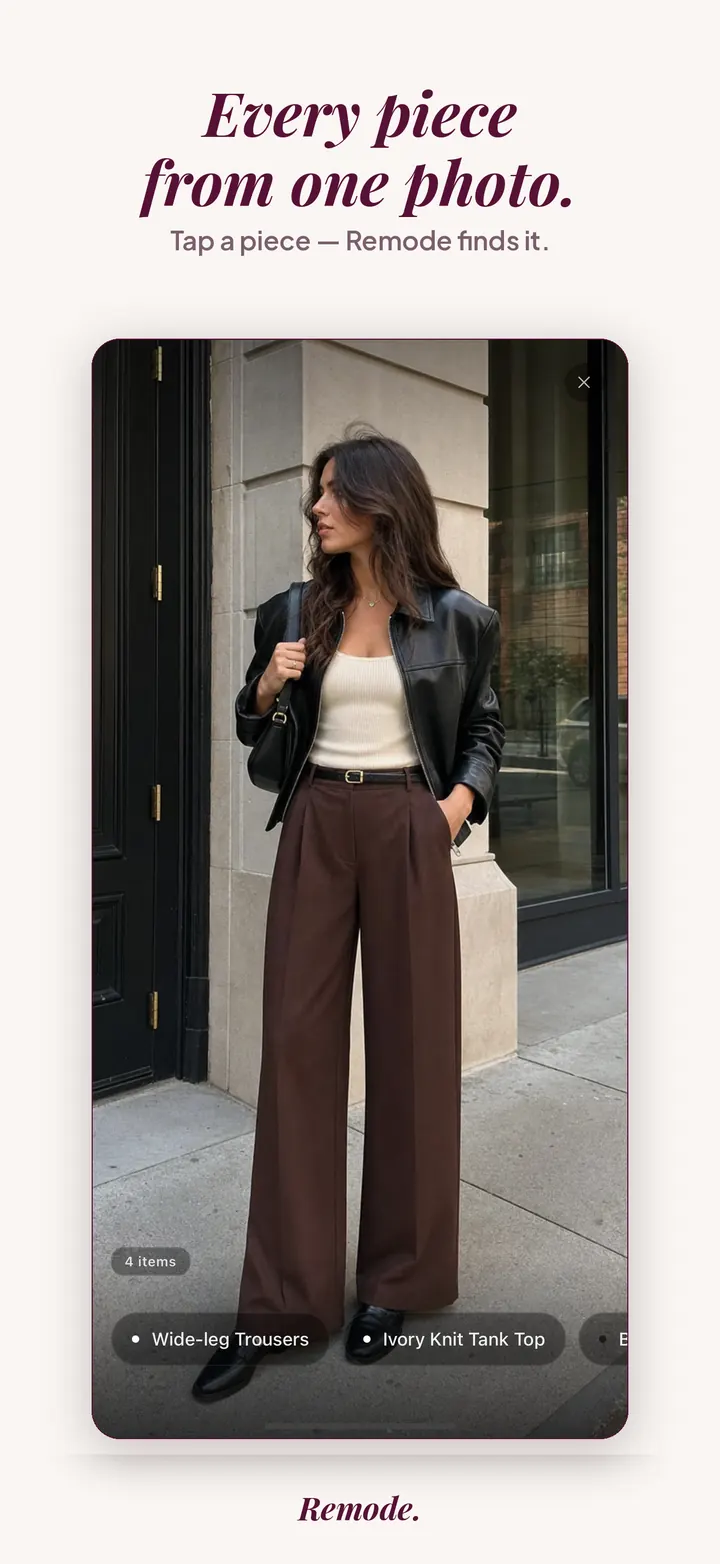
Find a similar piece
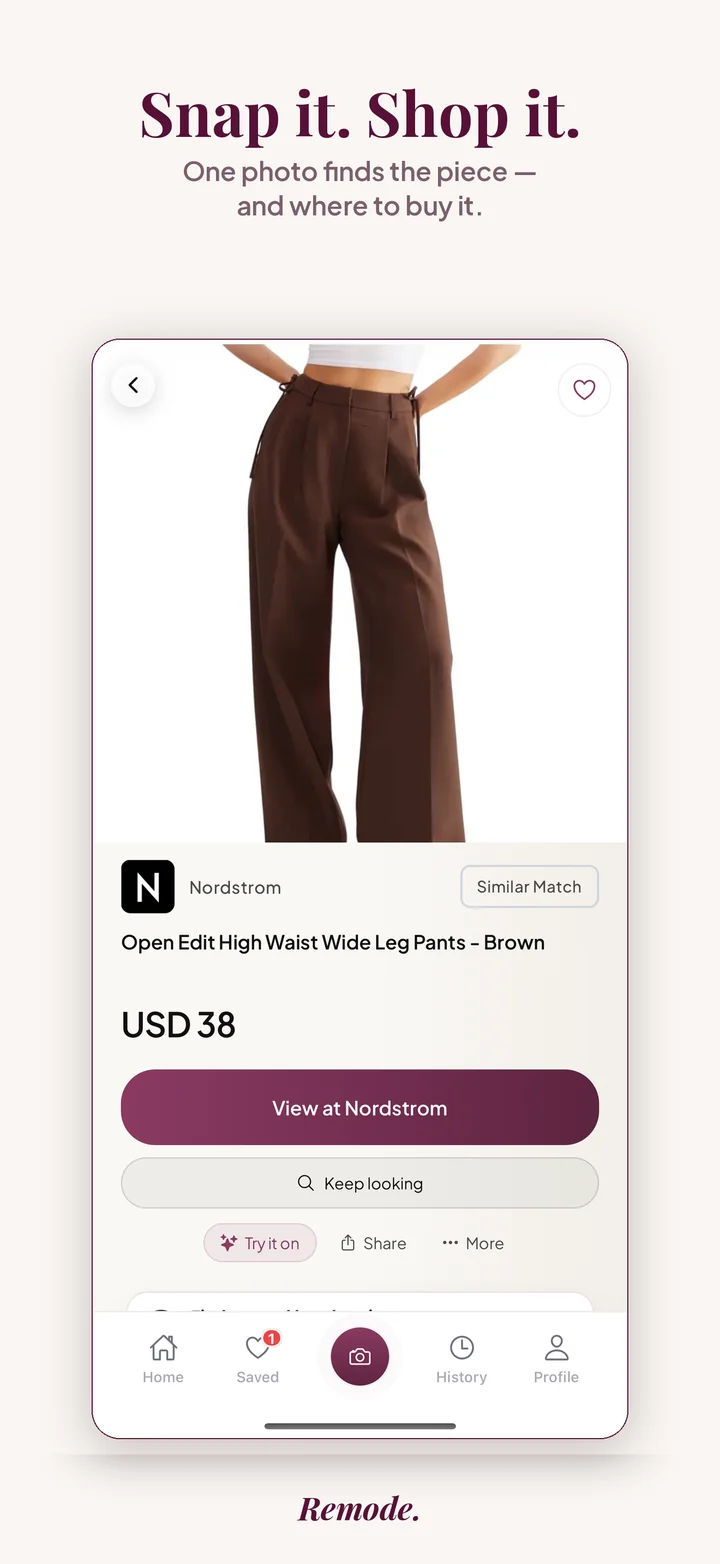
Actual app screens. This result is labeled Similar Match. Prices and availability can change.
When the goal is buying clothing, the answer needs product pages, retailer context, price signals, and alternatives.
Start from a photo, screenshot, product crop, or social post.
Choose the garment you care about when the image contains a full outfit.
Check retailer links, visual alternatives, second-hand options, and try-on where available.
Remode is designed to make the pre-store decision clearer. These signals help you judge whether a result is worth opening.
Is it an exact match, a strong visual match, or a similar alternative?
Compare the listed price with the retailer, shipping, and current availability.
Check similar styles or second-hand when the original is expensive, sold out, or hard to source.
This page is the hub for the Remode guides on visual clothing search. It explains the mechanics that every neighbouring guide relies on: how pieces are detected inside a picture, what each result label promises, and why the store list changes with your region. Read it first if you want to understand what happens between the upload and the store link.
The clothes finder guide covers the full loop from a saved photo to a running Hunt, and is the right start if your question is simply where to buy a piece you saw. The identify clothes app guide stays on the recognition step itself: what a detector can read from a silhouette, a print or a piece of hardware, and where category recognition ends and product identity begins. The fashion shopping assistant guide is for people who would rather hand the comparison work to an assistant, and it describes the Remode tool that assistants can call.
A pair of guides goes deeper on the labels. Finding the exact clothing match lays out what has to line up before Remode will call something exact, and how to handle a product that exists in several colorways. Finding similar clothes from a photo is the counterpart for the moment when the original is sold out, overpriced or was never sold online, and a close alternative is the realistic outcome.
If you are still deciding whether an image search is the right tool at all, stay here: the sections below spell out when it works, when it fails, and how to read what comes back.
A general reverse image search treats the picture as a whole. It looks for pages where that picture, or a near copy of it, already appears. That approach suits a meme, a landmark or a product photo lifted straight from a shop. It suits an outfit poorly, because the picture you hold is usually the only copy in existence: a street photo, a paused frame, a mirror selfie. There is no page to find.
Clothing adds a second problem. A single outfit shot can contain a coat, a knit, trousers, a belt, a bag, shoes and a watch. A whole-image search blends all of them into a single signature and returns pictures of people dressed in a broadly comparable way. That is a style result, not a product result.
A shopping-grade fashion search inverts the order. It first locates each piece in the frame, then searches every piece on its own against product listings rather than against web pages. The output is a product with a name, a price and a store that can ship to you, or an honest statement that no such product could be confirmed. Remode is built for that second job. It detects clothing, shoes, bags, jewelry, watches and wearable accessories in one image, lets you tap the piece you care about, and returns results labeled exact, best visual match or similar. Where a general engine hands you more images, a fashion search hands you a decision.
The labels are a statement about confidence, not about how attractive the result is. Exact is reserved for the case where Remode is confident the listing is the same product as the piece in your photo. If that confidence is missing, the label is withheld. The product principle behind this is short: if we're not sure, we don't pretend.
Best visual match exists because a search rarely fails cleanly. Often there is a listing that shares the cut, the color and the visible details but cannot be confirmed as the same item: the brand may be hidden, the photo may show only half the garment, or the piece may be an earlier season of a product that is still sold in a revised form. Instead of calling that exact and hoping, Remode presents it as the closest visual candidate and lets you compare with your own eyes.
Similar is the honest fallback. It says no confirmed match was found and offers pieces in the same category and style. Treat it as a shopping shortlist rather than as an identification.
Before you open a store, compare these points across the listings. Region: the stores shown ship to you, but the currency and the price may still differ from what the poster paid. Variant: a colorway, a wash or a hardware finish can change under the same product name, so compare the detail that made you want the piece. Condition: second-hand listings appear when found, and a pre-owned price is only comparable once you have read the condition notes. Price direction: if the item is above your budget, save it and let the Hunt tell you when it moves.
Some pieces cannot be found because nothing to find exists online. A one-off from a market stall, a tailored piece, a vintage garment sold once at a fair, or a sample that never went into production has no product listing, so the honest result is similar, not exact. The same applies to small labels that sell only in person or through a social account without a proper product page.
Some photos defeat detection. Heavy editing, a strong grain filter, a face-swapped or AI-generated image, or a frame where the garment is mostly hidden by a coat, a bag strap or a crop leave too little to compare. Very dark club footage and long-distance runway photos fall into the same group.
Some results are correct but unreachable. If no store that ships to your region carries the piece, the region-aware routing will not show you a store you cannot order from. In each case the practical move is the same: save the piece and let Remode hunt for a second-hand listing or a restock, or switch to the similar results and shop the look rather than the label.
Yes. It uses the image as the starting point and focuses the result around clothing shopping.
General image search often shows similar pictures. Remode adds retailer and price context for fashion items.
Yes. Screenshots are supported and are often the best starting point for social outfits.
Often, yes, because cut, fabric, color and hardware carry a lot of information on their own. A hidden brand mostly changes the label you get: without a legible logo or a distinctive detail, Remode is less likely to be confident enough to say exact and will show a best visual match or similar results instead.
Store routes are region-aware. Remode shows retailers that ship to the region you are searching from, so a friend in another country sees the retailers that ship to them. The product can be the same while the store names, the currency and the price differ. Ranking is not influenced by commercial terms in either case.
Yes. You can upload a photo in a web browser at remode.app/try/ and try it free without creating an account. The full experience, including saved pieces and background Hunts, lives in the free iOS app. There is no Android app; Android users can join the waitlist on the same page.
More Remode guides for visual clothing search, screenshot search, and outfit shopping.
Use Remode when similar images are not enough.