Fashion search

A Google Lens alternative built for clothes.

General image search can identify a garment. Remode is designed to help you actually shop it: exact matches, similar styles, prices, retailer links, second-hand options, and virtual try-on.

Search in your browser. The app is available for iPhone.

See a real app example

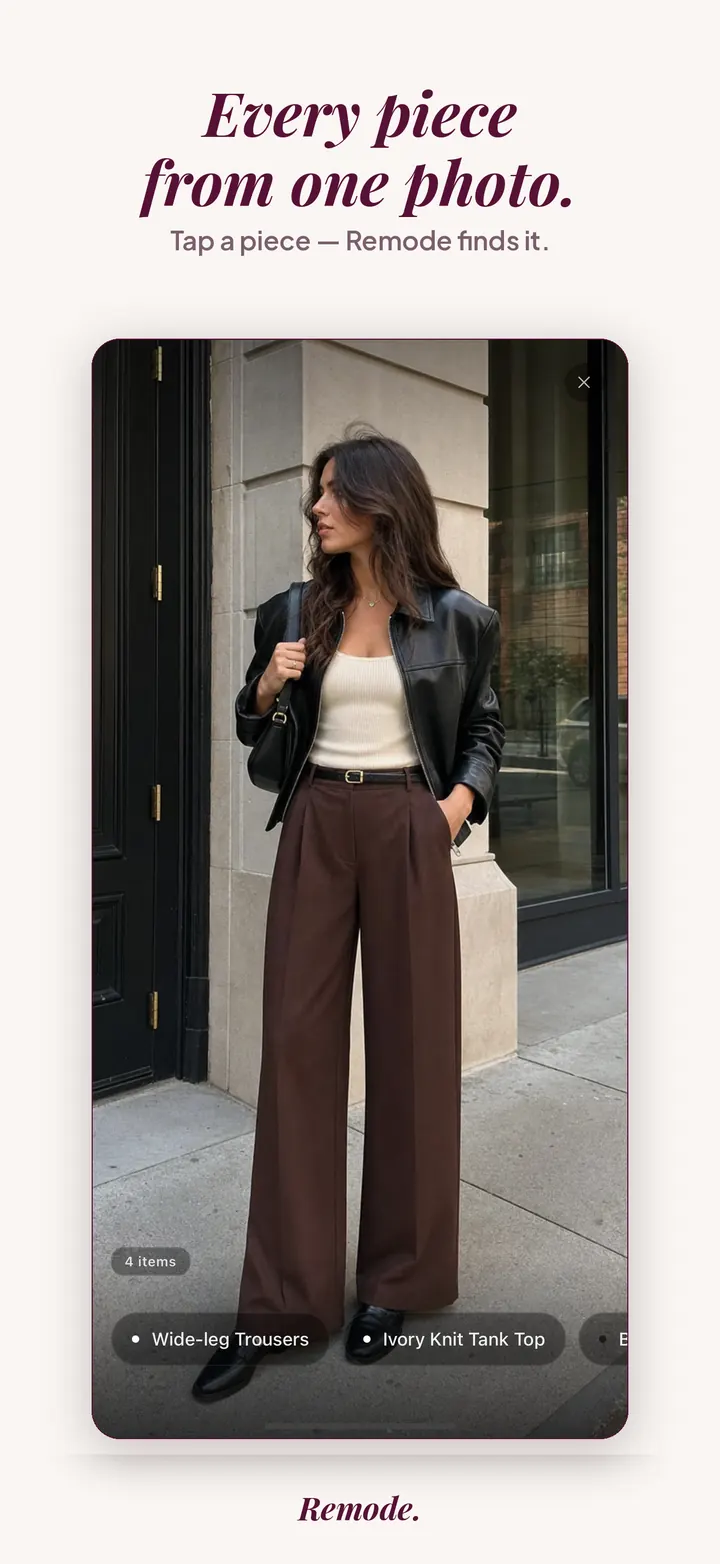
Start with a photo

Remode detects pieces in an outfit photo, including wide-leg brown trousers.

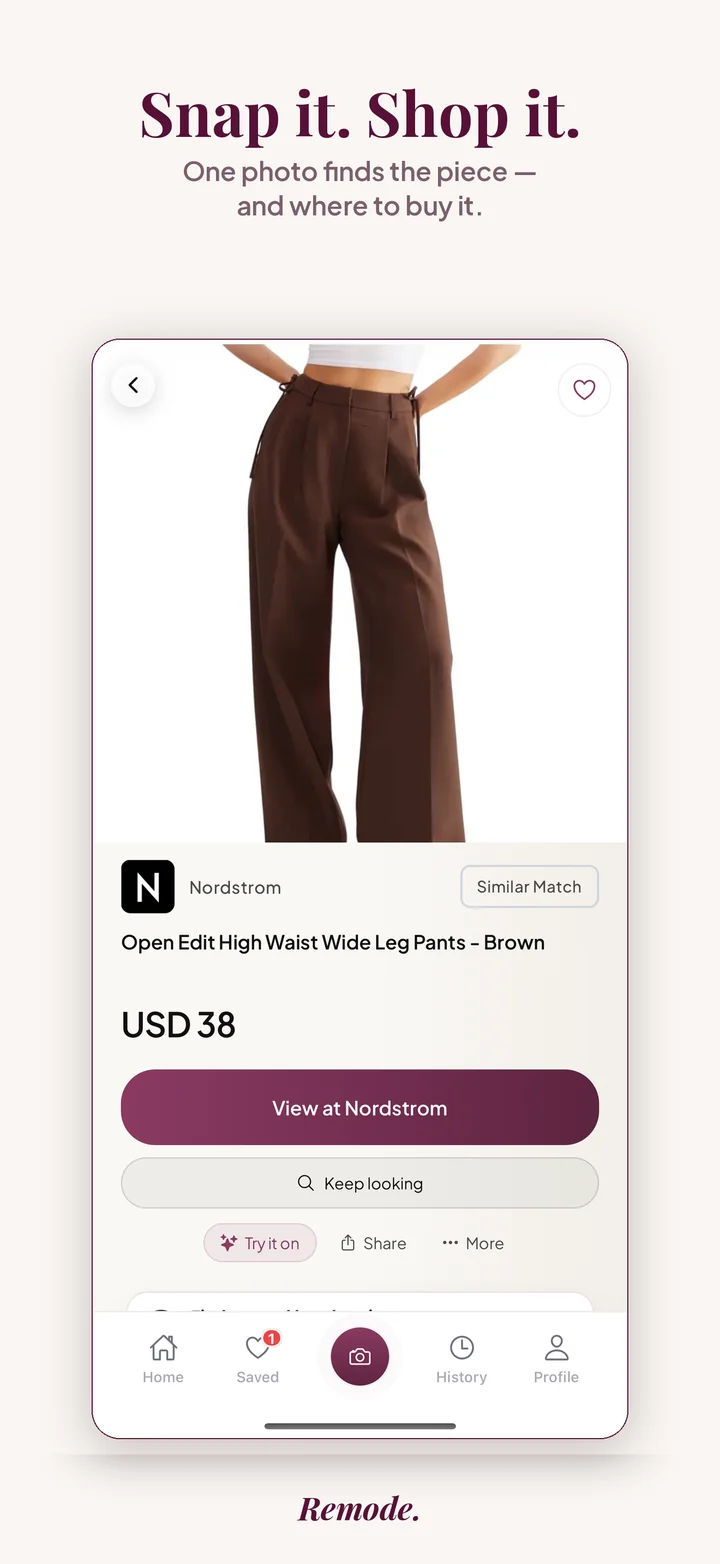
Find a similar piece

App result for brown trousers labeled Similar Match, with a link to the store.

Actual app screens. This result is labeled Similar Match. Prices and availability can change.

Why fashion search needs a dedicated app

Clothing search is not only about recognizing a product. The useful part is knowing where it is available, what it costs, whether there are alternatives, and how it might look on you.

Fashion-only results

Remode focuses the search around garments, not generic visual matches, so the results are easier to compare and buy.

Retailer context

See stores, prices, and product pages organized for the purchase — with match-confidence labels, a garment picker, a price watch, and a second-hand lane that general image search does not offer.

More than recognition

Use one flow for screenshot search, similar styles, second-hand discovery, and virtual try-on.

What to check before buying

Remode is designed to make the pre-store decision clearer. These signals help you judge whether a result is worth opening.

Match quality

Is it an exact match, a strong visual match, or a similar alternative?

Price and store

Compare the listed price with the retailer, shipping, and current availability.

Backup options

Check similar styles or second-hand when the original is expensive, sold out, or hard to source.

How this page relates to the app comparison and the reverse image search guide

This is the pillar of the Remode guides that compare visual search tools for clothing, and it takes on one question only: what changes for a shopper who swaps a general visual search for one built around garments. It is written for someone who already uses Google Lens, values it for what it does, and keeps hitting the same wall when the object in the picture is a coat they want to buy.

The comparison of apps that find clothes from a photo is the wider view. It puts several tools side by side, including Amazon Lens, Pinterest Lens and a browser-based option, and says which one suits which errand. Go there when you want a shortlist rather than a close look at a single alternative. That page also explains how to run your own fair test with the same photos in every app, which is the comparison that fits your own wardrobe.

For the mechanics, turn to the reverse image search for clothes guide. It covers what happens between an upload and a store link: piece detection, the meaning of exact, best visual match and similar, region-aware store routes and the background price watch. This page assumes that knowledge and concentrates on the contrast with a general engine.

Close by, finding clothes from a screenshot handles the input people usually have, and the identify clothes app guide separates recognizing a category from confirming a product, a distinction that sits at the heart of the Lens question. If you would rather try than read, the browser trial at remode.app/try/ runs 3 searches without an account.

What a general visual search is for, and where clothes shopping asks for something else

Google Lens is a general visual search built into Google products. Point it at a picture and it is designed to say what the object is, find images that look like it, surface pages where that image appears and, for products, show shopping results. That breadth is the point. The same tool reads a menu, names a plant, translates a sign and recognizes a sneaker, and for a shopper it is often the first thing tried because it is already on the phone.

The trouble starts with what a clothing shopper needs next. A picture of an outfit is not one object but several, and a general search tends to answer for the picture as a whole. A shopper wants the coat, not the ensemble. The result for a garment is often a mixture: editorial pages, re-posts of the same photo, lookalikes and genuine listings, presented without a clear statement about which is the actual product and which merely resembles it. A store may appear that does not ship to you. A price watch or a second-hand view is not what a general visual search is designed to provide. And once the tool has named the item, its job, as designed, is done.

A shopping-grade fashion search picks up where that ends. Remode marks each fashion piece in the frame, waits for you to choose one, and answers with listings that carry a label: exact, best visual match or similar, so you know whether you are looking at the product or at a cousin of it. Store routes are region-aware, second-hand listings appear when found, a saved piece is watched for price drops and restocks for free, and supported items can be previewed on you with AI try-on. None of that makes a general engine worse at its own job. It makes the shopper's next step shorter.

Switching from Lens to a fashion search: the practical sequence

  1. Keep the picture you would have given Lens. A screenshot from Instagram, a paused TikTok frame captured on your iPhone, or a product image saved from a retailer page all work; open Remode and upload it as it is.
  2. Let detection run over the whole frame before you crop. Instead of a single result for the picture, you get the fashion pieces marked individually: clothing, shoes, bags, jewelry, watches and wearable accessories.
  3. Tap one piece. Each piece you search counts as one search, and a guest in the browser has 3, so begin with the item you actually want to buy rather than with the whole look.
  4. Allow about 5 to 15 seconds while the piece is compared against product listings; the delay is the cost of getting a store and a price instead of a page of images.
  5. Look at the label before the picture. Exact says Remode is confident the listing and your piece are the same product. Best visual match points to the nearest listing when that confidence is missing. Similar means a stand-in that shares the style; none of the three is a picture of a picture.
  6. Check the store route and the region. The retailers listed are the ones that ship to your region, with the price next to the retailer name; if a listing you expected is missing, it may simply not deliver where you are.
  7. Decide, or defer. Open the store if the label, the price and the variant line up. If not, save it; Remode then watches in the background for a lower price, a second-hand option or a restock, free and without spending a search.

Reading a fashion search result when you are used to Lens

The habit to unlearn is scanning thumbnails for the one that looks right. A general visual search hands you a grid and leaves the judgment to your eye, which works well for a landmark and poorly for a black wool coat that many brands cut almost the same way. In Remode the judgment has already been stated in the label, and your job is to check that statement rather than to form it from scratch.

Exact is a claim of identity, made only when Remode is confident that listing and photographed piece are one product. Read the variant details anyway, because the same product can exist in several colorways or washes, and the label refers to the product, not to your preferred shade. Best visual match is a candid admission: this is the nearest listing, and it has not been confirmed as the same item. Compare the details that made you want the piece, such as a buckle, a pocket shape or a print scale, before treating the price as the price of your item. Similar is a shortlist of alternatives for the case where the original cannot be confirmed or bought.

Then look at what a general engine would not have shown alongside the image. The retailer name and the price sit together. The store route is region-aware, so a lower price in a store that ships to you is worth more than a lower price anywhere. Second-hand listings, when present, change what the piece costs. Commercial terms never influence the ranking. Some retailer links are affiliate links, and as an Amazon Associate Remode earns from qualifying purchases; that income never moves a listing up the list.

Getting a fashion search to do what a general one could not

  • Search the piece, not the outfit. Where you would have let a general search read the whole frame, tap the single garment you want; the other pieces are separate searches you can run later.
  • Feed it the frame a shopper would choose. A paused video frame where the garment faces the camera without motion blur carries more product information than a stylish but oblique pose.
  • Accept the label you are given. If the answer is similar, the original was not confirmed; forcing a similar result to be the product by squinting at it recreates the problem you were trying to leave behind.
  • Check the region before the number. A listing in another currency from a store that ships to you can be a genuine saving; a lower price from a store that does not is noise.
  • Save instead of bookmarking. A saved piece in Remode is watched for price drops, second-hand options and restocks without using a search, which is a different thing from a screenshot in a folder.
  • Keep Lens for the rest of the picture. If you also want to know the sofa, the city or the text on a sign in the same photo, that is what a general visual search is designed for, and there is no reason to give it up.

When a fashion search does not help either

A garment that was never sold online has no listing to match. Vintage one-offs, tailored pieces, samples and items from labels that sell only in person yield similar results and nothing stronger, and a general engine faces the same gap, because it lies in the world and not in the tool. The same goes for a picture that hides the garment: a heavy filter, a face-swapped image, a frame where a bag strap crosses the print, a runway shot taken from the back of the hall.

Some errands belong to a general search by design. Finding where an image was first published, identifying a non-fashion object, reading text in a photo or translating a label are the kind of job a general visual search is built for, and Remode does not attempt them. If your question is what a thing is rather than where to buy a garment, start there.

Remode is an iOS app; there is no Android version, and Android visitors can join a waitlist at remode.app/try/. Anyone can run 3 searches in a web browser at that address without an account, and a Chrome extension covers shopping on a computer. When a search returns similar results only, save the piece and let the free background watch report a second-hand listing or a restock rather than settling for the nearest lookalike today.

Common questions

Is Remode better than Google Lens for clothes?

Google Lens is useful for broad visual search. Remode is built specifically for fashion shopping, so it adds prices, retailers, similar styles, second-hand options, and try-on.

Can I use a screenshot instead of a photo?

Yes. You can upload a screenshot from TikTok, Instagram, Pinterest, a shop, or your camera roll.

Does Remode find exact matches?

When exact matches are available, Remode separates them from best visual matches and similar styles so the result is easier to judge.

Can I use Google Lens and Remode on the same photo?

Yes, and it is a sensible habit. Use the general search to identify the scene, a brand logo or the non-fashion objects, then upload the same screenshot to Remode to pick the garment and get listings labeled exact, best visual match or similar with region-aware store routes and prices. The tools answer different questions about one image.

Does Remode work as a Google Lens alternative on Android or on a desktop computer?

The app is iOS only; Android visitors can join a waitlist at remode.app/try/. On that page anyone can run 3 searches in a web browser without an account. For shopping on a computer there is a Chrome extension, and AI assistants can call the Remode tool find_fashion_items over MCP.

Why does Remode sometimes show fewer results than a general image search?

Because it returns listings, not images. A general search can fill a page with pictures that resemble yours; Remode shows products from stores that ship to your region and labels how confident it is about each one. A short list with a clear label is a different kind of answer, and an honest similar result is worth more than a long wall of lookalikes presented as the item.

Related guides

More Remode guides for visual clothing search, screenshot search, and outfit shopping.

Try the fashion search built for shopping.

Upload a photo or screenshot and let Remode find the item, compare alternatives, and show where to buy it.

Download on the App Store

Remode is an independent app and is not affiliated with, endorsed by, or sponsored by Google.